How Tangible Block Coding and Intensive Scaffolding Transform Novice Teachers into Confident EdTech Facilitators
Introduction: The Challenge of Introducing EdTech in Developing Regions
Integrating coding into early childhood education (ការអប់រំកុមារតូច) is a global priority. However, in developing regions like Cambodia, educational leaders face a twofold challenge: young learners lack foundational keyboarding skills, and educators themselves often have zero prior experience with computer science.
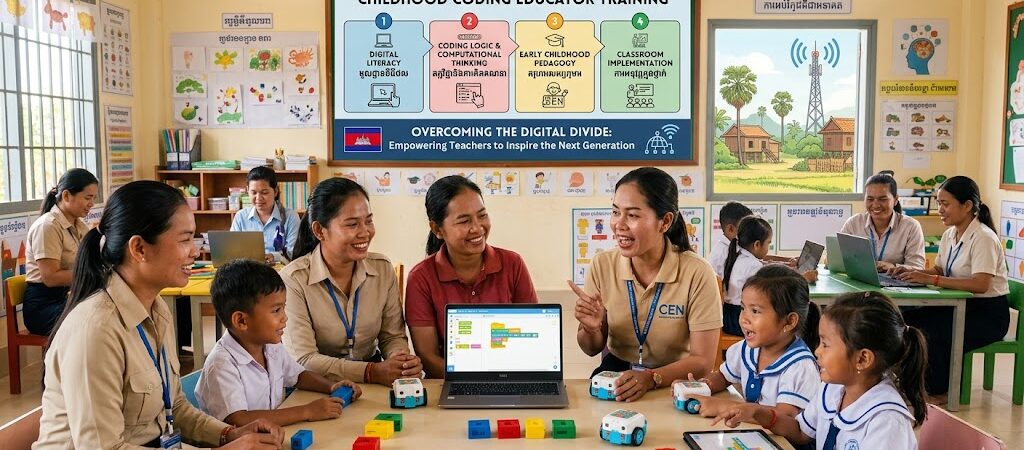
To bridge this digital divide, the Cambodia Education Network (CEN) made a strategic decision to bypass traditional screen-based programming languages like Scratch. Instead, we invested heavily in premium “Tangible Coding Blocks”—smart physical blocks with embedded chips that sync in real-time with a tablet. This innovative investment allows teachers and students to learn coding algorithms intuitively, simply by stacking and sequencing physical blocks.
The CEN Intensive Teacher Training Framework
Providing high-end EdTech equipment is meaningless without a robust teacher training program (ការបណ្តុះបណ្តាលគ្រូបង្រៀន). To ensure sustainable capacity building, CEN designed a highly structured, phased training framework tailored for absolute beginners.
Phase 1: Intensive Scaffolding (Weeks 1-2)
During the initial phase, teachers undergo rigorous, hands-on training for 1.5 to 2 hours, three days a week.
- Deconstructing the Basics: Instructors meticulously explain the function of each hardware component, the meaning of color-coded blocks, and the fundamental logic of sequence and execution. This intensive scaffolding is critical to alleviate initial tech anxiety.
Phase 2: Self-Directed Problem Solving & Classroom Transition
Once the foundational mechanics are understood, the training transitions from direct instruction to application.
- Application-Based Learning: Teachers independently solve step-by-step challenges provided by the coding application. By navigating these puzzles, they naturally internalize coding logic, building the confidence required to facilitate the same lessons in their own classrooms.
The Psychological Shift: Embracing the “Bug”
The most remarkable outcome of this tangible coding training has been the profound psychological shift in our educators. Teachers who were initially hesitant about technology quickly rediscovered the pure joy of learning.
When interacting with the tangible blocks, their engagement levels mirror the deep focus of their students. More importantly, when an error or “bug” occurs in their code, they do not feel defeated. Instead, the immediate, visual feedback from the blocks stimulates their curiosity. They become deeply engrossed in the debugging process, actively collaborating and iteratively refining their block sequences until the problem is solved.
“By experiencing the iterative process of debugging firsthand, our teachers have transformed from passive knowledge deliverers into resilient, innovative problem-solvers.”
Conclusion: Empowering the Next Generation of Tech Leaders
By carefully selecting intuitive, tangible EdTech tools and pairing them with an intensive, empathy-driven training framework, CEN has successfully empowered local educators. They are no longer intimidated by the digital era; they are now fully equipped and enthusiastically prepared to guide Cambodia’s young learners into the future of creative technology.