Introduction: Redefining STEAM in Evolving Educational Landscapes
Implementing STEAM (Science, Technology, Engineering, Arts, and Mathematics) education is no longer a luxury but a foundational necessity. In regions like Cambodia, traditional rote-learning frameworks are rapidly shifting toward interactive, interdisciplinary methodologies. However, bridging the educational gap requires more than Western theory; it demands proven, hands-on tools and structured teacher training tailored to local classroom realities.
The Synergy of 4D Frame Math and Coding Curricula
To cultivate true critical thinking, early childhood education must connect concrete tactile experiences with abstract digital logic. This is achieved through a strategically integrated pipeline:
-
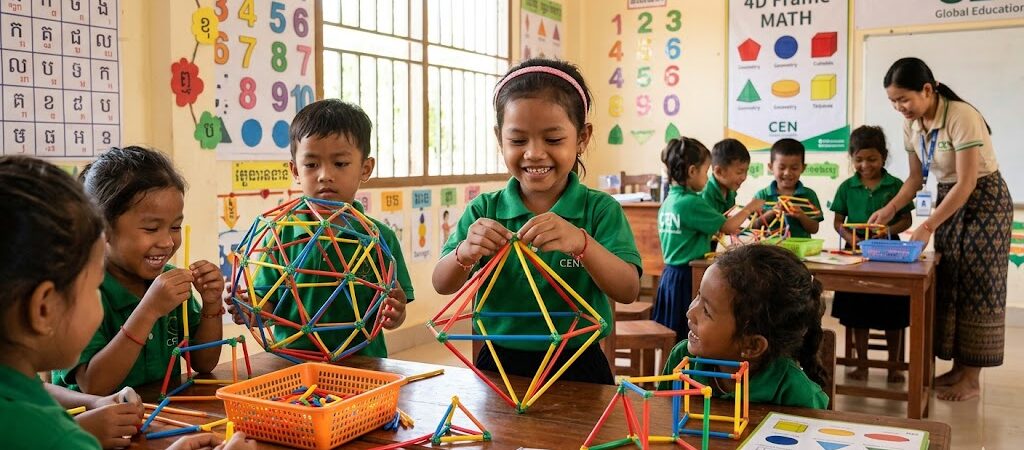
Tactile Mathematics with 4D Frame: By manipulating flexible straws and connectors, young learners transition seamlessly from 2D concepts to 3D spatial geometry. It builds structural resilience and cognitive agility without forcing rigid memorization.
-
Early Coding Foundations: Coding is the new literacy of the digital era. Introducing a systematic coding curriculum transforms students from passive technology consumers into active, analytical creators.
-
The Literacy Bridge: Advanced coding and scientific inquiry require strong linguistic comprehension. A robust literature-based literacy foundation ensures that students can articulate their problem-solving processes effectively.
Field-Proven Impact: Traditional vs. Innovative Realities
The Cambodian Educators Network (CEN) and Grace Mission International School (GMIS) have pioneered this empirical approach, proving that resource constraints can be overcome through high-quality curricular design.
| Key Educational Metric | Traditional Cambodian Classroom | CEN & GMIS Integrated Model |
| Student Cognitive Engagement | Passive listening and copy-writing | Active, self-directed hands-on inquiry |
| Spatial & Logical Reasoning | Rote memorization of abstract rules | Concrete 3D visualization via 4D Frame |
| Teacher Instructional Autonomy | Dependence on rigid, outdated textbooks | Creative facilitation using advanced guides |
“The transformation in student engagement was immediate. By replacing abstract textbook diagrams with 4D Frame modules, young learners who previously struggled with spatial reasoning began leading their own peer-to-peer training sessions.” — Cambodia Education Network (CEN) Field Report
Empowering Educators: Sustainable Teacher Training
The ultimate anchor of this educational evolution is sustainable teacher training. To successfully transition schools into innovative environments, educators must be provided with ongoing, high-quality professional development and structured instructional resources.
Providing teachers with comprehensive curriculum guides and active training workshops builds their instructional confidence. This systematic investment not only enhances the immediate classroom experience but also lays the groundwork for a highly knowledgeable, technologically literate society capable of leading Cambodia’s future growth.