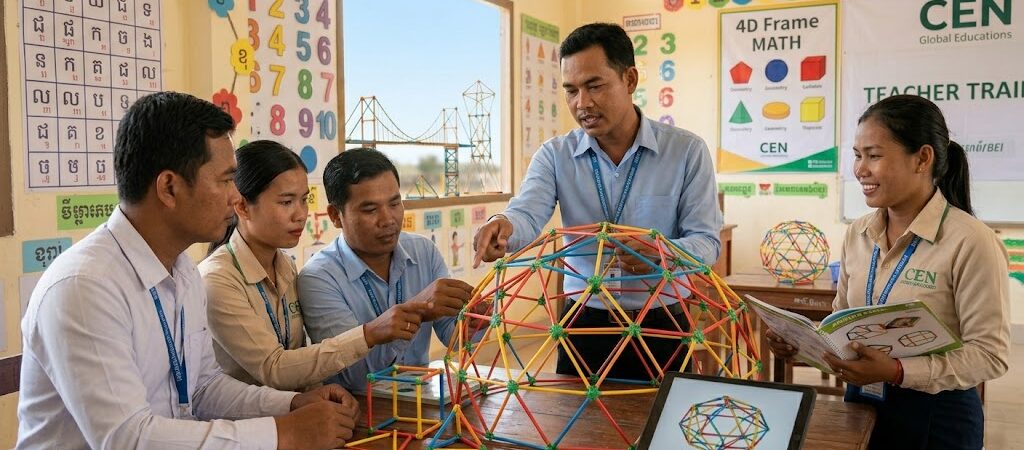
Introduction: Shifting from Screen Time to Logical Creation
In the digital age, teaching computer science to early learners is often misunderstood as merely increasing “screen time.” True digital literacy requires a pedagogical shift. For developing educational landscapes like Cambodia, introducing a systematic, long-term coding framework is not about training future programmers—it is about cultivating structural logic, algorithmic thinking, and problem-solving resilience from the very beginning of a child’s academic journey.
The Architecture of a 6-Year Sequential Coding Framework
A piecemeal approach to computer science fails to yield sustainable cognitive growth. To truly empower young learners, educational institutions must commit to a multi-year, progressive pipeline that scales alongside the child’s cognitive development.
-
Kindergarten to Early Elementary (Ages 5–8): Focuses on tangible, screen-free coding blocks and tactile logic kits. Students learn sequential thinking and cause-and-effect loops by physically manipulating directional commands.
-
Upper Elementary (Ages 9–12): Transitions from physical components to visual block-based programming languages. Students design their own interactive stories and basic geometric algorithms, directly bridging mathematical theory with digital output.
-
Cognitive Integration: This continuous 6-year loop ensures that analytical logic becomes a natural language for the student, significantly enhancing their overall academic performance in traditional science and literacy subjects.
Empirical Strategy: The Power of Weekly Teacher Workshops
The bottleneck of any advanced curriculum is never the technology itself, but the readiness of the educators tasked with delivering it. In environments where resources are historically constrained, building a robust network of confident instructors is the ultimate anchor for success.
| Training Parameter | Traditional Single-Shot Seminars | CEN & GMIS Continuous Training Model |
| Frequency & Structure | One-time annual workshop (Low retention) | Systematic, weekly collaborative sessions |
| Instructor Confidence | High anxiety when facing technical errors | High autonomy, collaborative troubleshooting |
| Classroom Delivery | Rigid adherence to abstract manuals | Fluid, innovative, student-centered facilitation |
“A curriculum is only as innovative as the teacher delivering it. By replacing sporadic annual seminars with mandatory, weekly continuous peer-training sessions, local educators transform from passive instructors into active pedagogical designers.” — Cambodia Education Network (CEN) Field Report
Conclusion: Nurturing Cambodia’s Next Generation of Leaders
Investing in a well-structured coding curriculum and continuous teacher training goes far beyond basic digital literacy. It is a sustainable investment in Cambodia’s intellectual infrastructure. By equipping local teachers with high-quality curriculum guides and ongoing technical support, we build an educational ecosystem where critical thinking and innovation thrive, successfully nurturing a highly knowledgeable society ready to lead on a global stage.